

by Vincent Muthee
Publicly traded firms are increasingly investing in crypto, which has become an emergent trend in the crypto investment scene These companies, called Digital Asset Treasury Companies (DATCOs), are now playing a critical role in institutional adoption of crypto assets, such as Bitcoin.
Unlike ETFs, whose aim is to track top prices of the asset, DATCOs keep crypto directly on their balance sheets. This emerging practice has the potential to revolutionize the interaction between the digital asset market and traditional finance.
DATCOs’ Holdings Now Exceed $100 Billion
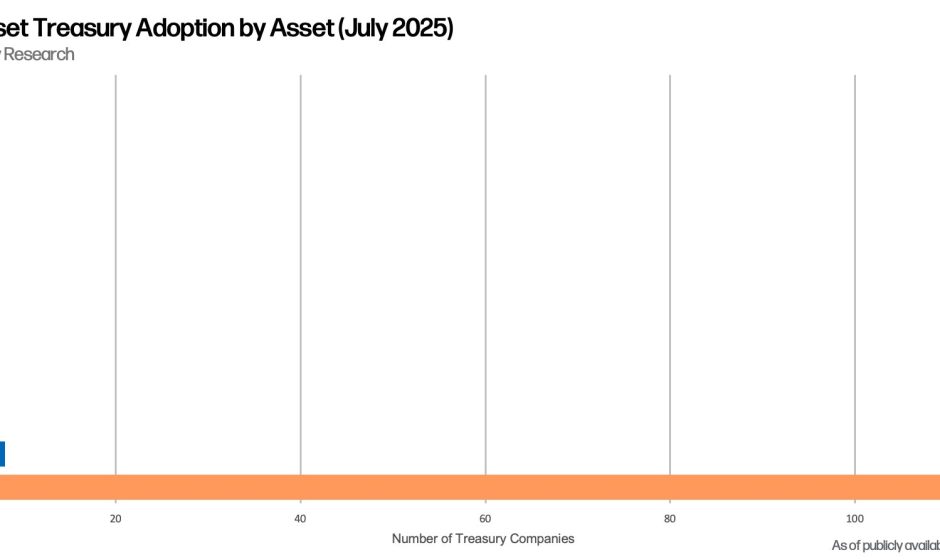
A recent report released by Galaxy Research suggests that DATCOs now hold over $100 billion in digital assets. This number shows the amount of capital held in publicly traded companies that are growing steadily in number. Some of the notable ones include, Strategy (MicroStrategy), Metaplanet, and SharpLink Gaming. These companies have embraced digital assets, mostly Bitcoin and Ethereum, as treasury reserve options.
“A new wave of public companies is using crypto as a capital strategy. $100B+ in BTC, ETH, & more,” Galaxy Digital wrote.

The structure of DATCOs is much different than that of ETFs. Whilst ETFs cater to inflows and outflows in their investor base, DATCOs are able to make proactive strategic decisions. This involves capitalization procedures such as Private Investments in Public Equity (PIPEs) and deployment of funds generated to buy more crypto.
According to the report of Galaxy, this flexibility develops a self-strengthening cycle. The stocks of these companies usually rally when these companies purchase large amounts of crypto. This increase in price results in the firm’s market capitalization and ability to attract further resources, thus forming a positive loop for further accumulation and market momentum.
Strategy Establishes the Standard
Strategy (formerly MicroStrategy) is the most popular example of a DATCO, accumulating a large amount of Bitcoin in its treasury since 2020. Data by BitBo shows that Strategy now holds a total of 628,791 Bitcoin, worth $71.98 billion per price as of this writing.

As outlined by the Executive Chairman Michael Saylor, the firm’s strategy is to use company funds and periodic fundraising to purchase more BTC. This strategy has resulted in great performances in the stock market and it has got other companies following the same path.
Recently, Strategy has been buying Bitcoins aggressively, cementing its position further as a Bitcoin holding company rather than a software company. This transformation has been welcomed by shareholders with the firm gaining more market valuations as Bitcoin continues to gain widespread adoption and rise in value.
Consequently, the Bitcoin treasury model used by Strategy has been picked up by other companies such as Metaplanet. This Japanese firm is now adopting a similar capital allocation approach. According to BitBo, the firm now holds a total of 17,132 BTC, worth $1.96 billion as of this writing.
The liquidity and visibility of public markets provides an advantage to these companies and additional firms could join up according to Galaxy Digital. The report noted:
“DATCOs have evolved from a novel capital allocation experiment into a structural source of buying pressure in crypto markets. Their continued rise has reshaped how market participants gain exposure to digital assets, and, increasingly, how they think about the relationship between crypto markets and TradFi. Looking ahead, DATCOs will continue to play an even larger role in crypto.”
DATCOs Face Risks from Over-Leveraging and Regulatory Uncertainty
Nevertheless, despite the upside potential, DATCOs aren’t without risks. The most prominent of them is the over-leverage risk. DATCOs which maintain a large amount of short-term finance or which depend to excess on PIPE transactions potentially expose themselves to a crisis.
Should the market swing in the opposite direction and the stock prices decline significantly, such companies might need to divest crypto assets to stabilize their portfolio or service loans. These liquidations may create colossal sell pressure within the market, such as the Terra and FTX collapses.
Additionally, there is a lack of a clear legal framework for DATCO operations. In the U.S. and Japan, the model could be disrupted by changes to the accounting regulations or the tax treatment of crypto. Galaxy compares this to the collapse of SPACs which rapidly lost its popularity as it came under legal and financial pressure.
How DATCOs perform moving forward will be dependent on the receptiveness of the model in the market and by regulators. Additionally, how successful companies balance the model to ensure mitigation of risks posed by having volatile assets on corporate balance sheets, will also chart the path for DATCOs.
#blockchain #crypto, #decentralized, #distributed, #ledger
