by Enoch Mwathwa
The crypto sector reacted sharply today after the MSCI revealed it is considering a major classification change for companies that hold large Bitcoin, Ethereum, or Solana reserves. The proposal targets firms like Michael Saylor’s Strategy, raising fears that such companies could lose index eligibility and face heavy market fallout. Saylor quickly addressed the issue, stressing that his company operates as a traditional business with a long-term Bitcoin strategy, not as a fund or trust.
Saylor Defends Strategy’s Business Model Amid MSCI Classification Review
The MSCI stirred debate after launching a consultation on whether Bitcoin treasury companies should be treated as funds instead of operating businesses. The proposal affects firms with more than half their reserves in digital assets. Strategy fits that description, which puts the company at risk of removal from major MSCI equity indices. The move triggered a fast response from Saylor, who argued that index labels do not define Strategy’s identity or mission.
In an X post, Saylor stated that Strategy continues to build the “world’s first digital monetary institution” on Bitcoin. He emphasized that the company’s model relies on a long-term strategy rather than passive asset holding. He noted that Strategy runs a $500 million software business alongside a treasury framework that treats Bitcoin as productive capital. This distinction, he said, separates the company from funds, trusts, and holding vehicles that rely on passive exposure.
Response to MSCI Index Matter
Strategy is not a fund, not a trust, and not a holding company. We’re a publicly traded operating company with a $500 million software business and a unique treasury strategy that uses Bitcoin as productive capital.
This year alone, we’ve completed…
— Michael Saylor (@saylor) November 21, 2025
He reinforced this argument by highlighting Strategy’s recent activity in capital markets. The company completed five public offerings of digital credit securities this year, raising over $7.7 billion in notional value. The latest STRE raise brought in $704 million, which Strategy used to buy more Bitcoin. These actions, Saylor explained, reflect active corporate operations, not passive holding.
MSCI Decision Could Reshape Index Eligibility for Bitcoin, Ethereum, and Solana Treasury Firms
Saylor also pointed to Strategy’s evolving products, including Stretch, a Bitcoin-backed credit instrument that offers a variable USD yield. He said this innovation proves that no passive vehicle can match Strategy’s scale or structure. According to him, funds hold assets, trusts protect them, and holding companies sit on investments, while Strategy creates and operates across capital markets. He insisted that this model makes the firm a genuine business rather than a fund.
However, the MSCI’s upcoming decision may still carry major consequences. Investment funds and trusts cannot be included in key equity benchmarks. If the MSCI reclassifies Bitcoin treasury companies, Strategy could be removed from indices such as MSCI USA and MSCI World. This risk already pressured MSTR stock, which fell nearly 2% today and more than 11% over the past week.
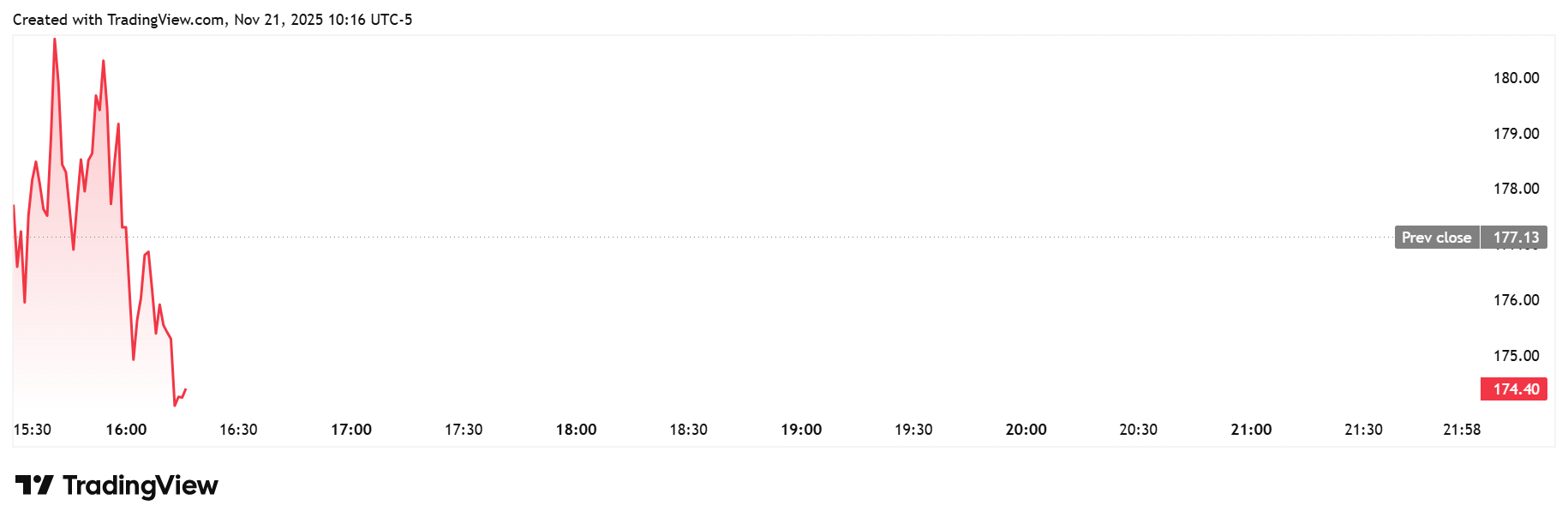
The ruling could also affect Ethereum and Solana treasury companies. Analysts argue that these firms may have a stronger case for remaining classified as businesses because they stake assets, run validators, and participate in DeFi to earn yield. The MSCI will make its final decision by January 15. Until then, uncertainty is likely to weigh on companies that use crypto as a core treasury asset.
#blockchain #crypto, #decentralized, #distributed, #ledger